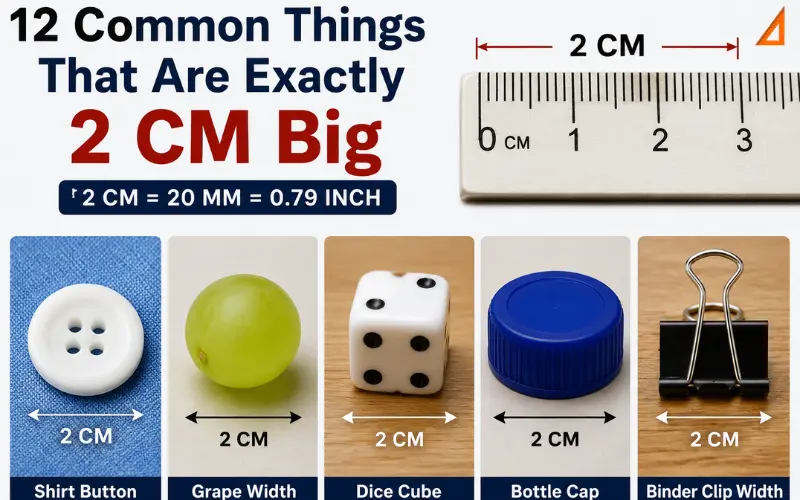

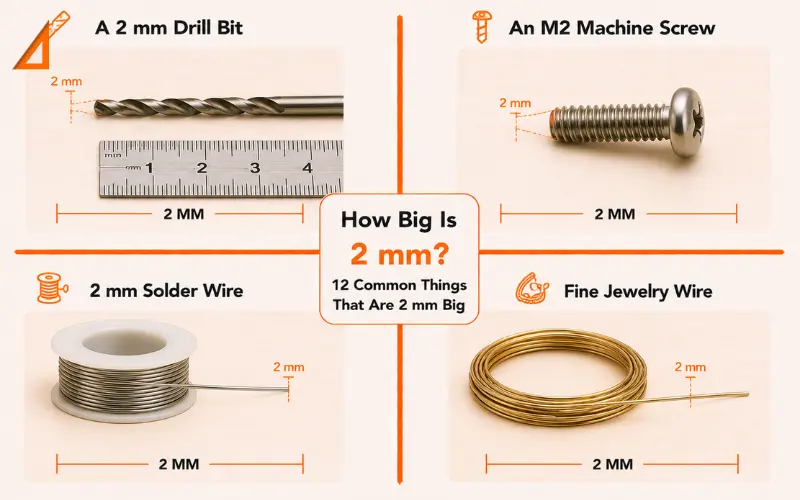
Two millimeters is a very small measurement, but it appears in more everyday products than you might expect. If you’ve ever wondered how big is 2 mm, looking at familiar objects is usually much easier than trying to imagine the measurement from a ruler.
Two millimeters equals 0.2 centimeters, 0.0787 inches, or 2,000 micrometers. At this size, a difference of just one millimeter can be significant. A 2 mm screw, wire, drill bit, or piece of mechanical pencil lead can look noticeably different from a 1 mm or 3 mm version.
The easiest way to understand what does 2 mm look like is to compare it with objects you can hold between your fingers. Small hardware, pencil leads, coins, electronic components, and craft materials can all provide useful visual references.
In this guide, you’ll discover 12 common things that are about 2 mm, including several objects with standardized or clearly specified dimensions. You’ll also learn how 2 mm compares with other measurements, how to estimate it without a ruler, and where this tiny measurement is commonly used.
Quick 2 mm Conversion
| Measurement | Equivalent |
|---|---|
| Centimeters | 0.2 cm |
| Inches | 0.0787 inches |
| Feet | 0.00656 ft |
| Meters | 0.002 m |
| Micrometers | 2,000 µm |
The most useful conversion to remember is:
2 mm = 0.2 cm = 0.0787 inches
Another simple way to think about it is that 10 measurements of 2 mm placed end to end equal 20 mm, or 2 centimeters.
What Does 2 mm Look Like?
Two millimeters is small enough to be difficult to judge accurately by eye, but it is still large enough to see clearly when compared with familiar objects.
A 2 mm measurement is roughly:
- the diameter of a 2 mm drill bit
- the diameter of 2 mm mechanical pencil lead
- the nominal diameter of an M2 screw
- close to the thickness of a US nickel
- similar to the diameter of some fine craft and jewelry wire
Because these objects are small, holding them next to a ruler or placing them beside a larger object makes the difference much easier to understand.
A useful mental image is a 2 mm drill bit. The metal tip is extremely thin compared with an ordinary household tool, but it is still substantially thicker than a hair or a sheet of paper.
Is 2 mm Big or Small?
2 mm is a very small measurement. It is only one-fifth of a centimeter and less than one-tenth of an inch. However, calling it “tiny” doesn’t mean it is insignificant.
At this scale, even a small numerical change can create a noticeable difference in the actual size of an object. For example, changing a drill bit from 2 mm to 3 mm increases its diameter by 50%. Similarly, a 2 mm screw and a 3 mm screw can look quite different when placed side by side.
This is why understanding small measurements visually can be useful when buying replacement parts or choosing tools.
12 Common Things That Are About 2 mm
| Object | About Size |
|---|---|
| 2 mm Drill Bit | Exactly 2 mm in diameter |
| 2 mm Mechanical Pencil Lead | Exactly 2 mm in diameter |
| M2 Machine Screw | 2 mm nominal thread diameter |
| 2 mm Allen Key | Exactly 2 mm hex size |
| 2 mm Solder Wire | Around 2 mm in diameter |
| US Nickel | About 1.95 mm thick |
| Fine Jewelry Wire | Around 2 mm in diameter |
| Guitar String | Close to 2 mm in diameter |
| Small Rubber O-Ring Cord | Around 2 mm cross-section |
| Model-Making Rod | Around 2 mm in diameter |
| Small Earring Post | Around 2 mm in diameter |
| 2 mm Knitting Needle | 2 mm diameter |
1. A 2 mm Drill Bit
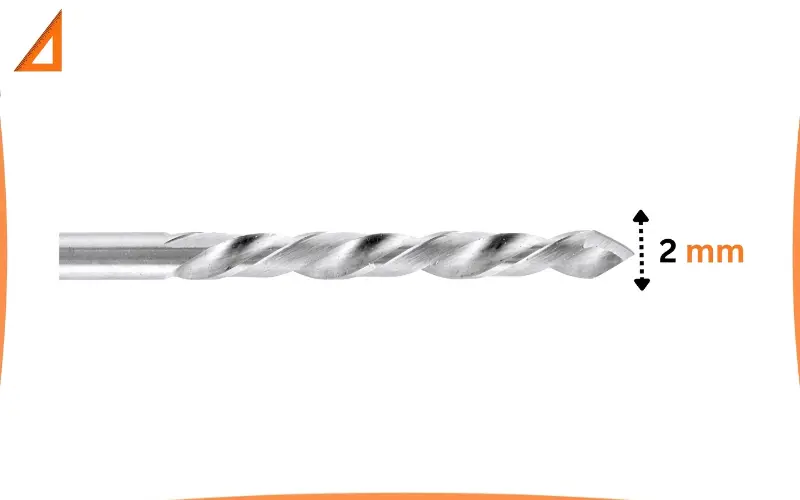
A 2 mm drill bit is one of the clearest examples of an object that is exactly 2 mm in diameter. Drill bits are manufactured in standardized sizes, so a bit labeled 2 mm is designed to create a hole approximately 2 mm across under normal drilling conditions.
These tiny drill bits are commonly used for electronics projects, model making, woodworking, jewelry work, and other precision tasks. Because the bit has to remove only a small amount of material, it is useful when a project requires a very precise hole.
Compared with a 1 mm drill bit, a 2 mm bit is twice as wide. A 3 mm drill bit is also noticeably thicker, making the 2 mm size a useful middle reference for small precision drilling.
Size: Exactly 2 mm in diameter
2. 2 mm Mechanical Pencil Lead
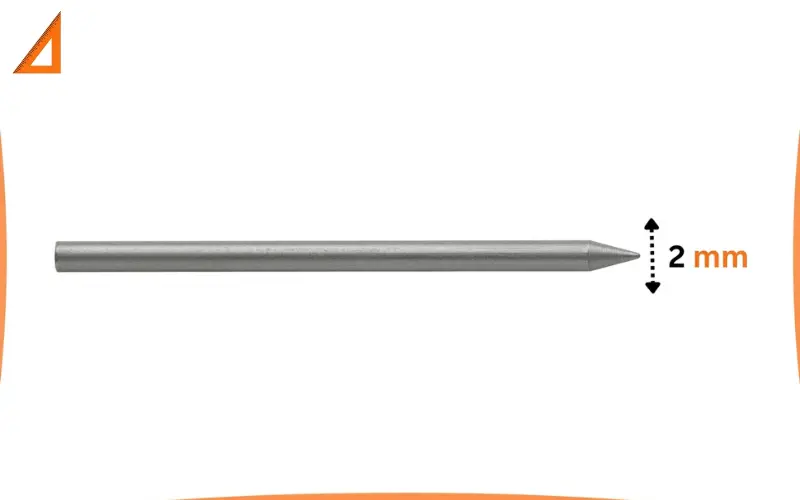
A 2 mm mechanical pencil lead is another excellent reference for understanding this measurement. Unlike the very thin 0.5 mm or 0.7 mm leads commonly found in ordinary mechanical pencils, 2 mm lead is much thicker and is typically used in clutch-style drawing and drafting pencils.
The standardized diameter makes this an especially useful object for visualizing 2 mm. When you hold a 2 mm lead beside a normal pencil lead, the difference is immediately noticeable.
Compared with 0.5 mm lead, a 2 mm lead is four times the diameter. That makes it surprisingly thick for something used to write or draw, even though it is still much smaller than the body of a normal wooden pencil.
Size: Exactly 2 mm in diameter
Related Post: How big is 3 cm?
3. An M2 Machine Screw
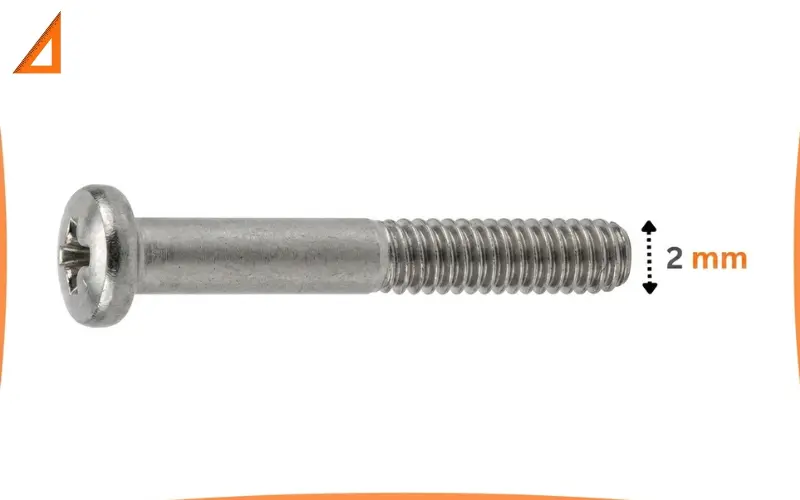
An M2 machine screw provides a particularly useful hardware comparison because the “M2” designation refers to a nominal thread diameter of 2 mm.
M2 screws are commonly used in small electronics, computer hardware, model kits, instruments, and other precision assemblies. Their small size allows manufacturers to secure components without requiring large mounting holes or bulky fasteners.
Compared with an M3 screw, an M2 screw has a smaller nominal diameter and looks noticeably more delicate. When several metric screws are placed together, the 2 mm designation becomes much easier to appreciate.
Size: 2 mm nominal thread diameter
4. A 2 mm Allen Key
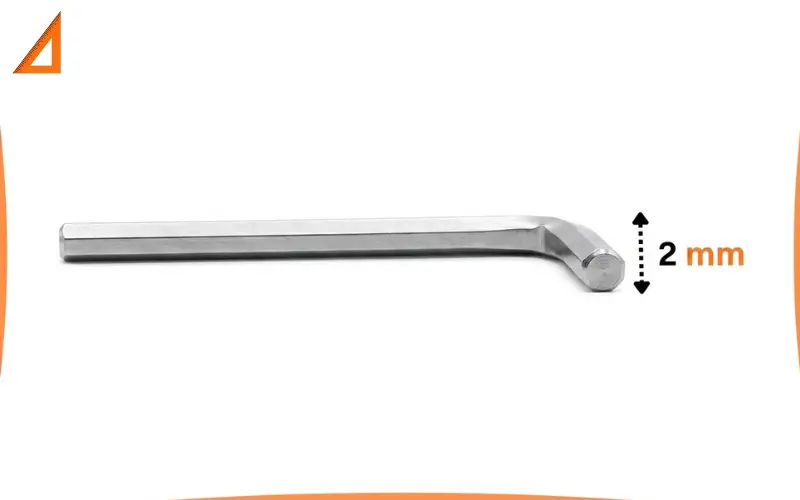
A 2 mm Allen key, also called a hex key, has a hexagonal working end sized at 2 mm across the relevant flats.
Small Allen keys are frequently included with furniture, bicycles, electronics, toys, machinery, and DIY products. Their compact size allows them to tighten small hex-socket screws without taking up much space.
Compared with a 1.5 mm Allen key, the 2 mm version feels noticeably thicker in your fingers. A 2.5 mm or 3 mm key looks progressively larger, making these tools useful references when comparing small measurements.
Size: Exactly 2 mm hex size
5. 2 mm Solder Wire
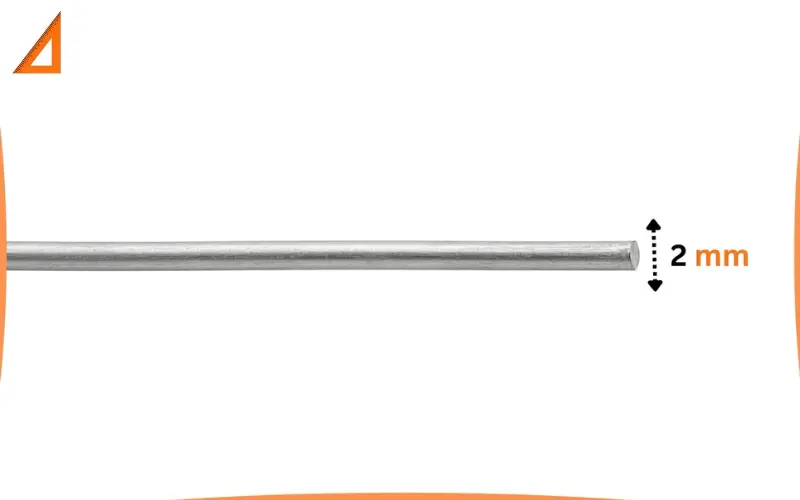
Some solder wire is manufactured with a 2 mm diameter, providing another useful electronics-related comparison.
Thicker solder wire is useful for larger joints where more solder needs to be deposited during the process. While solder is available in many different diameters, products specified as 2 mm provide a straightforward reference for this measurement.
Compared with fine solder wire around 0.5 or 0.7 mm, 2 mm solder looks considerably thicker. This difference is particularly easy to see when several wire sizes are placed side by side.
Size: Around 2 mm in diameter
Related Post: How big is 4 mm?
6. A US Nickel
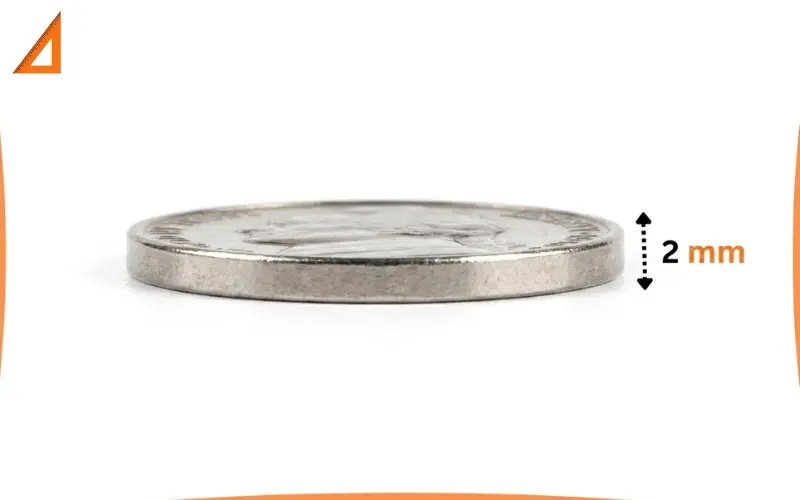
A US nickel is about 1.95 mm thick, making it remarkably close to 2 mm.
This makes the nickel one of the most convenient household references for understanding the measurement. If you have a US nickel available, its edge thickness provides a physical comparison that’s only slightly smaller than 2 mm.
Compared with a US penny, which is about 1.52 mm thick, the nickel is noticeably thicker. The difference is small in absolute terms but quite useful when trying to understand measurements in the 1–2 mm range.
Size: About 1.95 mm thick
7. Fine Jewelry Wire
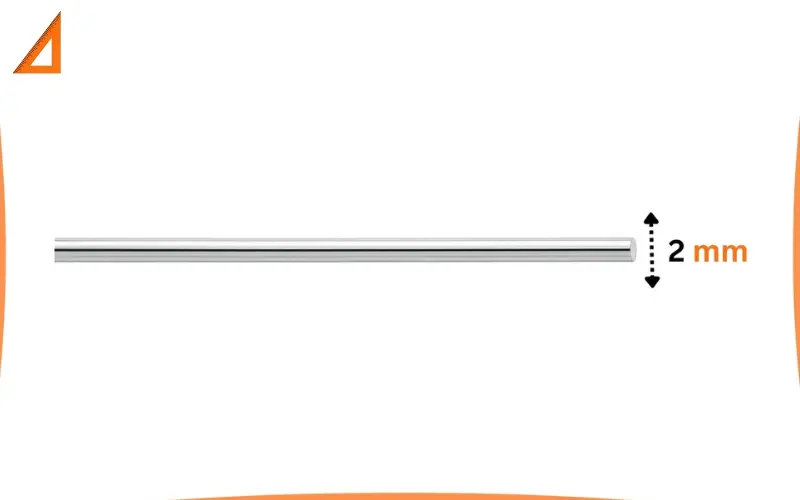
Fine jewelry and craft wire is available in sizes close to 2 mm in diameter. This type of wire is used for bracelets, necklaces, decorative work, wire wrapping, and handmade accessories.
At 2 mm, the wire is thick enough to have noticeable structure while remaining flexible enough for many craft applications. It is substantially easier to see and handle than very fine jewelry wire.
Compared with 1 mm wire, a 2 mm version has twice the diameter. That makes the difference easy to appreciate when both pieces are placed next to one another.
Size: Around 2 mm in diameter
8. A Standard SD Card
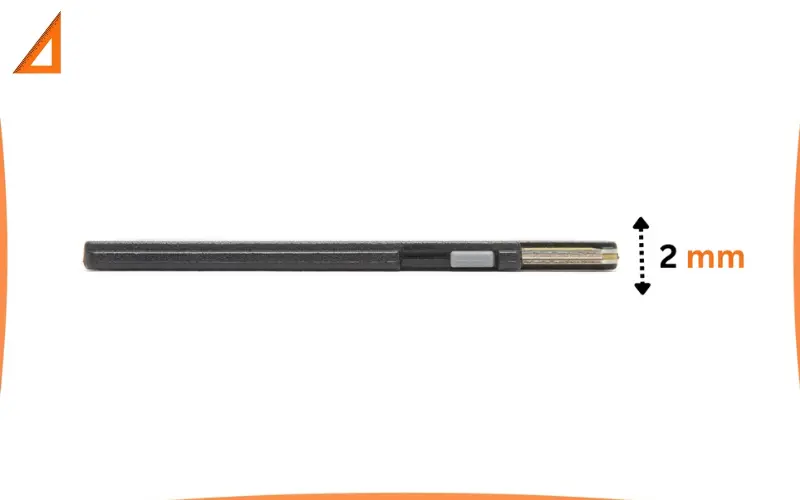
A standard full-size SD memory card is about 2.1 mm thick, making it an excellent real-world reference for understanding a measurement close to 2 mm. SD cards are manufactured to standardized physical dimensions so they can fit consistently into compatible cameras, computers, card readers, and other devices.
The thin profile is intentional. Memory cards need to contain electronic components while remaining slim enough to slide into small slots without adding unnecessary bulk. At just over 2 mm thick, an SD card demonstrates how manufacturers can package useful technology into an extremely thin physical form.
Compared with a 1 mm thickness, the SD card is roughly twice as thick. It is also only about 0.1 mm thicker than 2 mm, making it a particularly useful everyday reference when trying to visualize a measurement in this range.
Size: About 2.1 mm thick
9. A Small Rubber O-Ring Cord
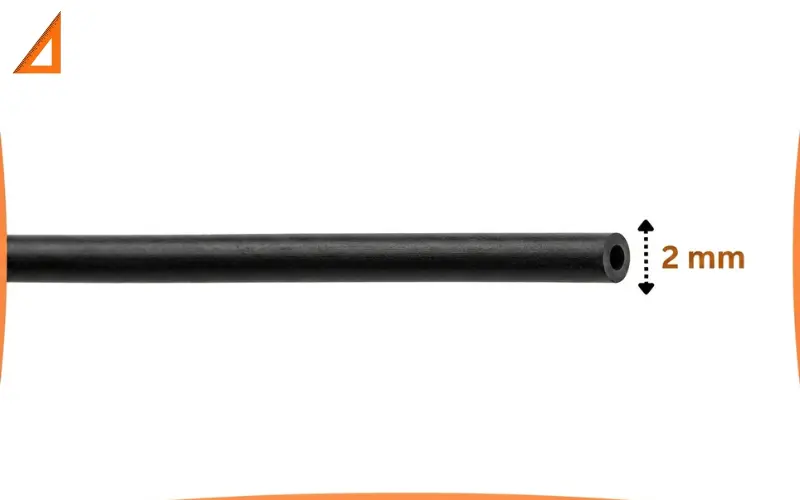
Some small rubber O-rings use approximately 2 mm-thick cord or cross-section material. O-rings are widely used as seals in plumbing equipment, machinery, automotive components, pumps, and other mechanical systems.
The circular shape makes this comparison particularly useful. Looking at the cross-section of the rubber shows how a seemingly tiny 2 mm measurement can be important for creating a proper seal.
Compared with a 1 mm sealing cord, a 2 mm version provides a visibly thicker cross-section and can occupy considerably more space inside a groove.
Size: Around 2 mm cross-section
10. A Model-Making Rod
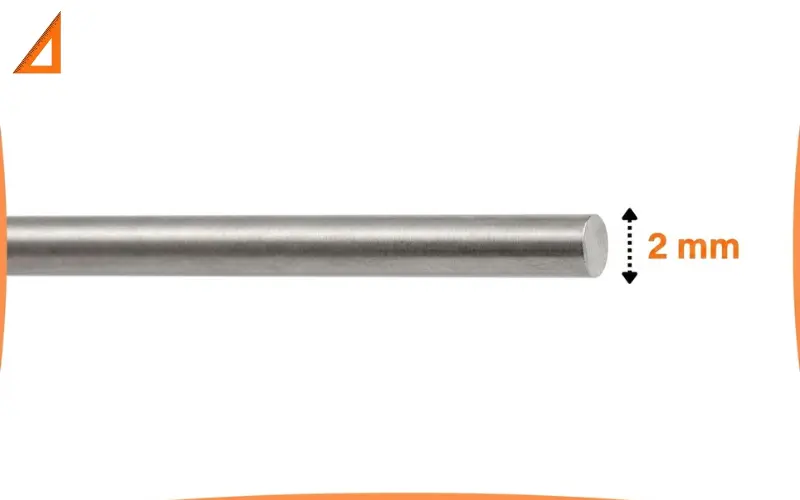
Small plastic, carbon-fiber, or wooden rods used in model-making are available in 2 mm diameters.
Model builders use these tiny rods to create structural supports, rails, frames, antennas, shafts, and other miniature components. Because scale models require precise proportions, small standardized diameters are especially useful.
Compared with 1 mm modeling rod, a 2 mm rod looks substantially thicker while remaining tiny enough for miniature construction. It gives a good idea of just how small 2 mm really is.
Size: Around 2 mm in diameter
11. A 0.080-Inch Guitar String
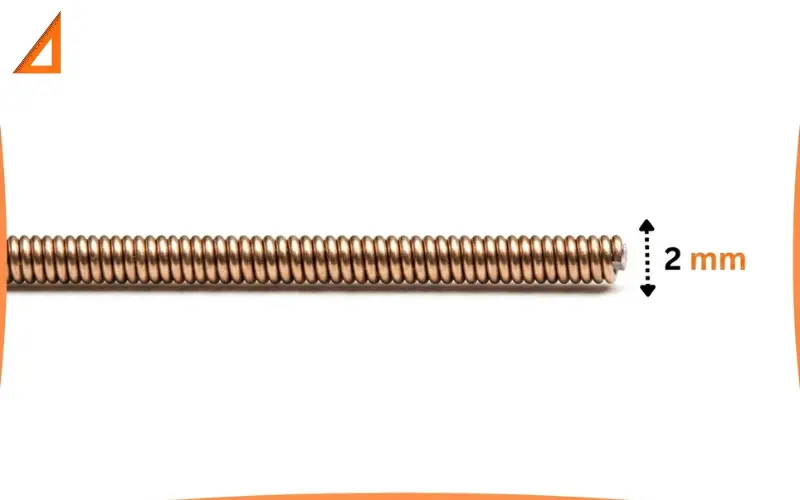
Some guitar strings are manufactured in a 0.080-inch gauge, which converts to approximately 2.03 mm in diameter. This provides a useful real-world example of a string that is extremely close to 2 mm across.
Thicker guitar strings are used for lower-pitched notes and are particularly common among bass guitar and specialty string sets. String manufacturers specify gauges precisely because even small changes in diameter affect tension, feel, tone, and playability.
Compared with a 1 mm string, a 0.080-inch string is roughly twice as thick. At approximately 2.03 mm, it is also an excellent example of how a measurement that looks tiny numerically can represent a noticeably substantial piece of material when viewed up close.
Size: 0.080 inch ≈ 2.03 mm in diameter
12. A 2 mm Knitting Needle
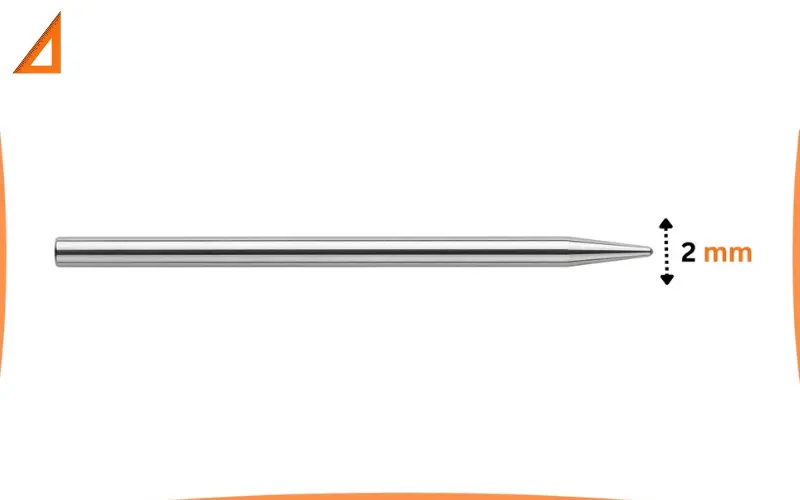
A 2 mm knitting needle is another useful example of the measurement. Knitting needles are commonly sold according to their diameter, and 2 mm is a recognized small needle size used for fine yarn and detailed knitting projects.
The thin shaft gives knitters the precision needed to work with lightweight yarn. Although the needle is much thinner than many everyday pencils and pens, it is still easy to hold and see.
Compared with a 4 mm knitting needle, a 2 mm needle is exactly half the diameter, making the difference particularly easy to understand when both sizes are placed side by side.
Size: 2 mm diameter
2 mm Compared With Human Fingers
Two millimeters is much smaller than the width of an adult finger.
For most adults, a fingertip is roughly 15–20 mm wide, depending on the person. That means 2 mm represents only a small fraction of the width of a fingertip.
This is why using your finger alone to estimate 2 mm isn’t very precise. You can use your fingertip as a general reference for how small the measurement is, but you should not assume that a fraction of a fingertip is exactly 2 mm.
A better approach is to compare your finger with a known 2 mm object, such as a 2 mm drill bit or 2 mm mechanical pencil lead.
Where You’ll Notice 2 mm in Everyday Life
Although 2 mm is tiny, this measurement is surprisingly important in products that require precision.
Electronics
Small screws, connectors, mounting hardware, wires, and mechanical components can use dimensions around 2 mm. Electronics manufacturers rely on small measurements because internal components need to fit inside increasingly compact devices.
Tools and Hardware
Drill bits, Allen keys, machine screws, and precision tools are frequently sold in exact millimeter sizes. A difference of only 1 mm can change the size of a hole or fastener significantly.
Crafts and Jewelry
Wire, leather cord, beads, rods, and other craft materials often come in millimeter-based sizes. A 2 mm difference can affect how easily a material fits through a hole or how an accessory looks when finished.
Drawing and Modeling
Mechanical pencil leads, modeling rods, miniature components, and fine tools all benefit from precise millimeter sizing.
This is why 2 mm may be tiny, but it is not an insignificant measurement.
2 mm Compared With Other Measurements
Understanding nearby measurements can make 2 mm easier to visualize.
| Measurement | Everyday Reference | Difference From 2 mm |
|---|---|---|
| 1 mm | Very thin wire | 1 mm smaller |
| 2 mm | 2 mm drill bit | Reference point |
| 3 mm | Small drill bit | 1 mm larger |
| 5 mm | Small hardware component | 3 mm larger |
| 10 mm | 1 centimeter | 8 mm larger |
| 20 mm | 2 centimeters | 18 mm larger |
The difference between 1 mm and 2 mm may seem insignificant when written as numbers, but the physical difference is 100%.
Likewise, 4 mm is twice the thickness of 2 mm, while 10 mm is five times as thick.
This shows why millimeter measurements are so important when dealing with small hardware, electronics, tools, and precision components.
How to Estimate 2 mm Without a Ruler
Estimating 2 mm without a measuring tool is difficult because the measurement is so small. However, familiar objects can help.
One of the easiest methods is to use a 2 mm mechanical pencil lead if you have one. Because the lead is manufactured to a specific diameter, it provides a much better reference than guessing from your finger.
A 2 mm drill bit or 2 mm Allen key is another excellent reference. These tools are manufactured in standardized sizes, so their labeled measurement provides a reliable physical example.
You can also compare 2 mm with a US nickel, which is approximately 1.95 mm thick. The difference is only about 0.05 mm, making it remarkably close to the target measurement.
If you don’t have any of these objects, remember that 2 mm is one-fifth of a centimeter. It is also about one-tenth of an inch.
These methods are useful for visual estimation, but they should not replace a caliper or precision ruler when exact measurements matter.
2 mm Compared With Everyday Sizes
| Measurement | Everyday Reference | Difference From 2 mm |
|---|---|---|
| 1 mm | Very thin wire | 1 mm smaller |
| 2 mm | 2 mm drill bit | Reference point |
| 3 mm | Small drill bit | 1 mm larger |
| 5 mm | Small hardware component | 3 mm larger |
| 10 mm | 1 centimeter | 8 mm larger |
| 20 mm | 2 centimeters | 18 mm larger |
This comparison shows just how small 2 mm really is.
A 10 mm measurement is already five times larger than 2 mm, while 20 mm is ten times larger. That’s why objects that look only slightly larger can actually have substantially different dimensions when measured precisely.
Related Measurement Guides
If you’re learning to visualize small measurements, these guides may also be useful:
- How Big Is 5 mm?
- How Big Is 6 mm?
- How Big Is 7 mm?
- How Big Is 8 mm?
- How Big Is 9 mm?
- How Big Is 10 mm?
Comparing neighboring millimeter measurements is one of the easiest ways to train your eye to recognize small differences in size.
FAQs
How big is 2 mm?
2 mm is equal to 0.2 centimeters or approximately 0.0787 inches. It is a very small measurement that can be visualized using a 2 mm drill bit, pencil lead, or small hardware component.
What does 2 mm look like?
2 mm looks roughly like the diameter of a 2 mm drill bit or 2 mm mechanical pencil lead. A US nickel is also very close, measuring about 1.95 mm thick.
Is 2 mm smaller than 1 cm?
Yes, 2 mm is much smaller than 1 centimeter. Since 1 centimeter equals 10 mm, 2 mm represents only one-fifth of a centimeter.
What objects are about 2 mm?
Objects around 2 mm include drill bits, mechanical pencil lead, M2 screws, Allen keys, solder wire, jewelry wire, leather cord, and small modeling rods.
How thick is 2 mm in inches?
2 mm is approximately 0.0787 inches thick. In everyday terms, it is slightly less than one-tenth of an inch.
How can I measure 2 mm without a ruler?
You can compare the measurement with a 2 mm drill bit, 2 mm mechanical pencil lead, or M2 hardware. A US nickel is also very close at approximately 1.95 mm thick.
Conclusion
Understanding how big is 2 mm can be difficult when you only see the number, but familiar objects make the measurement much easier to visualize. A 2 mm drill bit, mechanical pencil lead, M2 screw, Allen key, and knitting needle all provide practical references that turn this tiny measurement into something you can actually picture.
Two millimeters is small enough to be easily overlooked, yet it plays an important role in electronics, tools, hardware, jewelry, crafts, and precision manufacturing. Once you become familiar with a few 2 mm objects, you’ll have a much better sense of what 2 mm looks like whenever you encounter the measurement in product specifications or everyday projects.